Avoiding Power Struggles With Teens – Part I

Title

Avoiding Power Struggles with Teens

Part I – “Because I Said So”

Power struggles occur in all kinds of relationships: family members,Teen on Computer significant others, even co-workers. But for this short series, I am going to focus specifically on the parent/teen relationships and their power struggle dynamics. So first, let us learn more about what a power struggle is and its effects on the parent/teen relationships.  



I will start with an example (Name, age, and situation has been redacted/ changed to protect identity):

Single Mom and Teen, a 15-year-old girl, sit in the office across from me. It’s their 2nd session in, and they are arguing back and forth like I’m not even in the room.  

Mom is telling Teen, for what feels like the 1,000th time to the teen, why Teen isn’t allowed to do X, Y, or Z this week even though all her friends are going. Teen is complaining, arguing, and rolling her eyes. She is giving every reason she can think of for why it would be ok for her to go.

Teen: “Why can’t you just let me live my life my way?”

Mom: “Because I said so. Trust me; I am doing this for you, not to you”

Teen: “You’re so mean! You don’t understand me! I don’t care; I’m going. You can’t stop me.”

Both turn and stare expectantly at me as if I am to tell them they are right and the other one is wrong.

Mom feels justified as she is establishing her role as the authority/the parent and trying to show Teen that she does know what it is like and doesn’t want Teen to fall into the same traps/setbacks she did when she was a teen.

Teen only hears mom dictating her life. She feels trapped, alienated, and justified in not following orders because she is old enough to make her own decisions.


The battle of wills has started, and that, my friend, is a classic parent/teen power struggleTeen Power Struggle. So what exactly is a power struggle? It is a relationship dynamic where one person tries to exert their “power” or influence over another, who thus pushes back and tries to overpower the original. Think of it as kind of a tug-of-war over decision-making power.
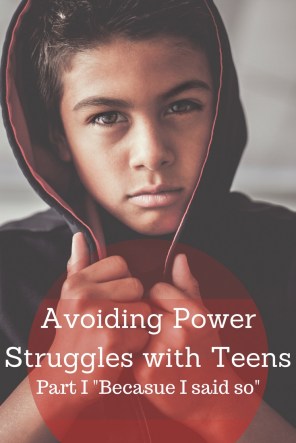
Parents – an important thing to remember is that power struggles with teens are never a
positive thing. They create distance and hostility. If you win by rigidly holding your ground or overpowering your teen, you lose. Your “winning” can create teens who do not feel understood, supported, or protected by their parents. They feel powerless. Teens who feel powerless will often seek other outlets to gain power.

This can look like many different things: from defiance and non compliance, to belittling others around them, bullying, even engaging in risk-taking behaviors such as experimenting with drugs, alcohol, sex, running away, or self-harming behaviors.


The best course of action is to not get pulled into your teen’s attempts at engaging in power struggles. Remember, it takes two people for a power struggle to occur.  

Tips on Avoiding Power Struggles with Teens

  • Model Calmness – Taking a minute to self-regulate will made a big difference.Anger creates anger. Calm creates calm. If you find yourself getting worked up during a discussion with your teen, take a time-out for a breather and to re-regulate back to calm.
  • Remain Neutral – If a decision is not immediately needed, remain neutral and let them know you will consider it. Actually consider it, learn more about situation, and ask questions to show them you are being objective.
  • Help Teen Problem Solve – Help them think of both sides of the argument and the reasons why you might answer differently than they want.
  • Ignore Minor Behaviors – Pick and choose your battles. It is more important to help them regulate their emotions when dealing with disappointment than to reprimand and punish minor behaviors. If they need help managing disappointment, you can deflect, distract, or use humor. Know that some teens just need some space. You know your teen the best.

Teen Girl Dyed Hair


I know what you’re probably thinking, and I agree – this is easier said than done. It takes work. It takes practice. It takes self control. It takes patience. It sometimes takes a professional to help you, the parent, work through negative patterns with your teen that have been established to create better, healthier ways of communicating.

Stay tuned this week to continue to learn more tips and strategies in dealing with Teen Power Struggles. In the next part of our series, Part II “Let’s get Creative”, Putting Solutions Before the Problem, we will look at how to work with your teen on finding positive ways that their thoughts and actions can count. Until then…

Best Wishes,

Lori Torres, LMFT

profile

Lori Torres, LMFT

Lori Torres is a Marriage and Family Therapist who has worked with teens and their families for over five years. Do you want to work on your relationships with your teen? Call today for a free 15-minute phone consultation to see if I might be of further assistance in helping you create happier, healthier ways to communicate.

 980-349-8119


TOWERS COUNSELING SERVICES | 120 GREENWICH ROAD CHARLOTTE, NC 28211

PH: 980-349-8119

The Teen Years: A Roller Coaster of Emotions

teenswing

What is typical teen behavior anyways?

Being a teenager is rough. Parenting a teenager is rough too. I have yet to meet a parent who was “fully” prepared for the teen years. You can read up, learn from others’ experiences, etc., but until you experience it with your own teen, there is no amount of prep that will get you fully ready. Typically, teen years are hands down the hardest years, and each generation of teen has their own challenges. Ask any adult, and they most likely will have a story about their teen years and the struggles they went through.

teen-girlThere are a lot of expectations of teens these days. Expectations of success are even higher now than for teens of previous generations. There is a need to excel in advanced topics of science, technology, and mathematics, as well as being well-rounded individuals with other varied interests. On top of all of that, the expectations to think and act like the “adults” they are becoming. Children and teens have the innate desire to make the people they care about happy, and they thus internalize these expectations. Unhealthy thought patterns may begin to emerge, such as, “No one understands me,” “Things never go my way,” or, “I can’t do anything right.” Teens also experience the Tidal Wave of Emotions that accompanies their developmental changes.

When your teen is struggling with the Tidal Wave of Emotions, unhealthy thought patterns, and an inability to clearly communicate their thoughts, feelings, or behaviors, this oftentimes leads to family conflicts, problems with school or peers, poor decision making, depression, anxiety, and defiant and disruptive behaviors. This is also the time period when they are at risk of being introduced to drugs, alcohol, sexual activity, and other risk-taking behaviors. All this on top of the typical stressors of transitioning into adulthood and preparing to leave home can be a lot to manage, even for the most prepared teens.

Signs of teens struggling to cope with increased life stressors can include: anxiety, depression, being more irritable that usual, poor school performance, and/or complete avoidance of school.

teen-boy

When does getting professional help make sense? Here are some things to consider:

  • It is typical for teens to display some mood swings or irritability when stressed, angry, or experiencing big changes like the start of new school year. It is of concern when irritability is pervasive, or ongoing, despite positive events or things in their life.
  • It is typical for teens to increasingly want their space and privacy. It is of concern is when teens completely withdraw and demonstrate poor connections to family, school, and/or peers.
  • It is typical for teen to catch a cold about 4-5 times per year. It is of concern if you notice that your teen has frequent somatic complaints, such as stomachaches, headaches, or not feeling well — that cannot be explained by illness. This can be stress related and a sign of struggling to cope.
  • It is typical for teens to feel overwhelmed. It is of concern when it leads to avoidance of school or other activities they once enjoyed, or making poor decisions that could have serious consequences.

How Therapy Helps Teens therapy-for-teens

Therapy helps by giving teens strategies and techniques to cope with life stressors and learn to “surf” the waves of big emotions, in a safe, private way; away from the eyes of peers and pressures of typical teen life. Therapy can help teens think critically about choices they are making, evaluate their strengths, areas for growth and development, and help empower them to create unique solutions to their own problems.

Therapy can assist teens in practicing and implementing self control by stopping to think about their actions and replacing unhealthy thought patterns with healthier ones. Lastly, therapy can increase their communication skills, which can make them more assertive and improve on their confidence and self-esteem.

As a Marriage and Family Therapist, I have over 5 years experience working with children, adolescents/teens, and their families. In my work with teens, I use systemic theory to guide treatment. In this approach, I recognize that each teen has unique “systems” that surround them, such as family, friends, and other important figures and organizations, which play a significant role in the development teens. I work collaboratively with the teen’s systems to address behaviors, interactional patterns, and ways to support change and positive development. This assists in building stronger relationships with the loved ones in their lives and creating happier, healthier teens.

Best Wishes,

Lori Torres, LMFT

Licensed Marriage and Family Therapist


Looking for help for your teenager in managing life and teen stressors? Call today for a free 15-minute phone consultation to see if I might be of further assistance in helping your family980-349-8119


TOWERS COUNSELING SERVICES | 120 GREENWICH ROAD CHARLOTTE, NC 28211

PH: 980-349-8119

Taking Care of You

yoga_relaxation_selfcare

Taking Care of You

And Using Self Care with Intentionality

Every time you fly, you will hear the safety announcements and pay somewhat close attention.  But if the cabin was to lose pressure, would you remember what to do?

The airlines will tell you,

“If cabin pressure should change, panels above your seat will open, revealing oxygen masks; reach up and pull a mask towards you. Place it over your nose and mouth, and secure with the elastic band, that can be adjusted to ensure a snug fit. The plastic bag will not fully inflate, although oxygen is flowing. Secure your own mask first before helping others.”

Secure your own mask first before helping others. It may be tempting to put the mask on first for your son, daughter, or even helping your husband or wife, but do not do this. Do you know why this is? Because it is a known fact – you cannot help anyone else if you are unconscious due to lack of oxygen. That means before you help your loved ones, you must help yourself first. This improves the outcomes for everyone.

Relationships are very much like this. Taking care of yourself so that you can take care of others is essential. We juggle so many different roles and responsibilities these days. It is important that we remember to slow down, breath, and smell the roses every now and then.

Being present with our loved ones, be it our children, wives, husbands, friends, or other important people in our life, is what fills our relationships with the “good stuff”: Love, Laughter, Joy, and Memories.  But it is hard to be present if you are holding on to too much of that “other stuff”.

Taking only 5-10 minutes a day to do something for yourself is all that it takes to help your brain start packing up and shipping out “the other stuff”.

Five to ten minutes the day is the minimum amount of time, but feel free to spend more! There is no wrong way to practice self-care. Personalize it to you and your lifestyle. This is one of those investments that the more you put into it, the more you will get out of it.

Look for things that speak to your soul, things that offer comfort and joy. Oftentimes people find targeting their senses, sights, sounds, smells, tastes, and touches, offers great benefits. A walk in nature, sitting in silence, deep breathing exercises, savoring the taste of a special tea or coffee, cooking a special meal, reciting special prayer, calming music, giving yourself a manicure, a warm shower or bath; these are just a few of thousands of different things you can do for you!

Now, you probably are already saying that you do something for yourself, but you must be intentional with the use of your time for self care. Do you do it because it part of your morning or evening routine?  Then, while technically yes it is something for you, it is not intentional “self care”.

Intentional self care is making the choice to do sometime outside of your routine, for you, to better you. Sounds a bit selfish? Not at all; it is mandatory maintenance that your body, mind, and soul needs to be able to work properly.

So, I ask you… How will you practice intentional self care today?

Looking for ways to continue to enhance your life and relationships? In just a brief number of sessions, We can work towards building and enhancing your relationships and leading to a happier, healthier you. Call Today for a Free 15-minute phone consultation of how I can help 980-349-8119

Best Wishes,

Lori Torres, LMFT

yoga_relaxation_selfcare


TOWERS COUNSELING SERVICES| 120 GREENWICH ROAD CHARLOTTE, NC 28211
PH: 980-349-8119


Celebrating Love 365 Days of the Year

celebrating-love-365-days-of-the-year

Love is in the Air! Happy Valentine’s Day! 

On this wonderful day, I want to share my hopes for you and your relationships.

I hope today you and your significant other celebrate your relationship and the journey you have been on together.

I hope today you both cherish the moment, cherish today. Take the opportunity to show your love, appreciation, and fondness with each other.

I hope you look back on your relationship today and remember good memories – first dates, special places, and events that have special shared meaning.

Remember that to keep your relationships strong, it takes work. Your relationships should be celebrated 365 days of the year, not just today! There are sweet things to do throughout the year to enhance and build upon the foundation of your relationship.

Author and public speaker on marriage, family, and relationships, Gary Chapman, demonstrates this in his work and making sure you and your partner are speaking the same “Love Language”. He separates qualities of love into 5 “Love Languages”: Words of Affirmation, Quality Time, Receiving Gifts, Acts of Service, and Physical Touch.

Keep reading to learn more about Gary Chapman’s “Love Languages” and my suggestions on ways to implement and celebrate your love 365 days of the year.

Words of Affirmation:

Kind, encouraging words to and about the other person and their contributions to the relationship. It is important to be specific – while “I love you” is a strong, loving statement, “I love how considerate you are when you do ___” can be even stronger. Other ways to demonstrate Words of Affirmation, tell them what their contribution to the relationship means to you, tell them what characteristics they have that you admire, or tell them what they do well in the relationship (ex: “I love how you know the exact right moment to give me a hug when I am upset”).

It is important to be specific – while “I love you” is a strong, loving statement, “I love how considerate you are when you do ___” can be even stronger.

Quality Time:

A personal favorite! Spending uninterrupted time focusing on each other and making memories. No phones, no electronics, and no kids. (Family quality time should be spent too, but that is a topic for another article) Need some ideas?

Go on a Date Night: Go out somewhere special for dinner, or go out for drinks, coffee, or ice cream. If you’re not a “go out” type of people, that is okay too. Instead, cook dinner together. Plan for a special meal, go shopping together for ingredients, and enjoy the experience of cooking. Or unleash your inner child and order takeout, build a fort with pillows and blankets, and eat the takeout in the fort while joking and talking about “the good stuff”.

Outing to Somewhere Special and/or New: Search Groupon, Living Social, or other discount sites looking for a new event to try like a Zoo, Museums, an Amusement Park, a Festival, etc. Be a tourist in your own city. Afterwards, talk about the event as if a critic. Was it 3 out of 5 stars? What did you like? What didn’t you like?

Play A Board Game Together:  (Not monopoly, it’s the end all of relationships…well, okay, maybe a bit of an extreme reaction to it, but remember it is just a game. Don’t take it too seriously and have fun!) Bonus points if you play a cooperative game, like Pandemic or Flash Point, where you have to join together to save people or the world.

Have your partner teach you something new that they like and then vice versa.

Receiving Gifts:

A token to show your significant other that you were thinking of them. It doesn’t have to be of a great sum of money. Remember, it is the thought that counts.

“Gifts come in all sizes, colors, and shapes; some are expensive, and others are free… Gifts may be purchased, found, or made.” – Gary Chapman

Gift of self or of being present for major life events and crises is a gift in and of itself. Taking time away from work or other obligations for your partner means that they are a priority in your life.

Acts of Service:

Doing things for your significant other or with them in mind can be an act of love. These do not have to be major feats. There is no act of service too big or small. Again, remember it is the thought that counts.

For example, take their car to be filled up with gas and through a car wash when they don’t have the time to do it themselves. Have a meal ready and waiting when they get home after a particularly long shift at work. Maintain the house or do a chore they typically would do.

Physical Touch:

Physical Contact can be a powerful way to communicate love. A reassuring touch on the shoulder, holding hands, kisses, hugs, or even sexual intimacy can communicate our love and affection towards our significant other. It is important to communicate with your partner how you do and do not want to be touched and vice versa. Asking them specifically, “What is your favorite way for me to touch you?” can help shed light into what they need from you.

Getting to know your partner and their love languages is part of the journey.  Some people need only one or two of these to feel loved, others need all of them. Communication is vital, so ask your partner, “How can I best show you I love you?” If they don’t know, start experimenting with each other’s different love languages.

Try to show your love in new ways, talk about it, and make it a way to celebrate your love 365 days of the year!

Looking for ways to continue to enhance your relationship? Couple therapy is not just to resolve couple’s conflict. In just a brief number of sessions, Couples Counseling can help enhance an already strong relationships and re-energize your love and passion for one another. Interested in hearing more? Call today for a free 15-minute phone consultation of how I can help take your relationships to new heights. 980-349-8119

Best Wishes,

Lori Torres, LMFT

celebrating-love-365-days-of-the-year


Towers Counseling Services| 120 Greenwich Road Charlotte, NC 28211
Ph: 980-349-8119